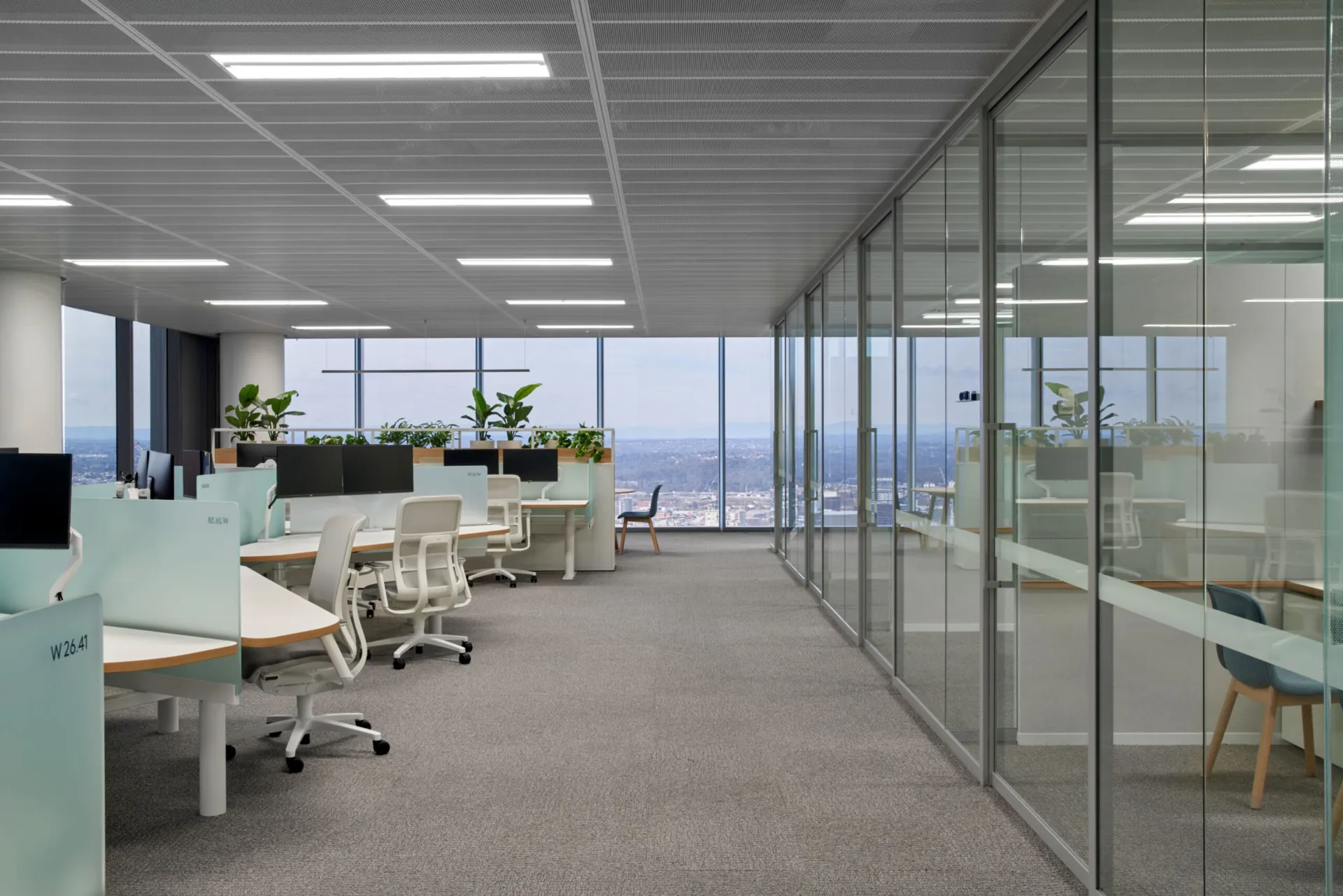
Understanding how glass type influences the acoustic performance of glass partitions
Several factors influence the acoustic performance of glass walls. The wall system, glass type, glass thickness, jointing method and overall configuration can all affect the level of sound insulation achieved.
Acoustic test evidence should therefore relate to a clearly defined and tested system configuration. The test certificate should identify the system, glass specification and test method, allowing the stated performance to be understood and assessed accurately.
It is also important to recognize that laboratory test results relate to the complete tested specimen. The performance achieved on site may be affected by installation quality, interfaces with adjoining construction, doors, penetrations and sound travelling through surrounding elements.
How glass specification affects wall acoustics
The type and thickness of glass must be considered alongside the acoustic rating required for the complete wall system.
For example, the PurOptima 117 Plus single-glazed system has been tested with different glass specifications, achieving the following laboratory ratings:
-
½" tempered glass in a single-glazed, multi-module screen: STC 30
Test reference: 542-434 -
9/16" acoustic laminated glass in a single-glazed, multi-module screen: STC 40
Test reference: 438126/01/P004
Where higher acoustic ratings are required, a double-glazed system may be appropriate. The Revolution 100 double-glazed system can accommodate different combinations of glass type and thickness, including:
-
½" tempered glass and ½" acoustic laminated glass: STC 48
Test reference: 2151-1845 -
Two panes of ½" acoustic laminated glass: STC 51
Test reference: 2151-1848
These results demonstrate why the performance of acoustic glass walls should not be judged solely by whether a system is single or double glazed. The complete tested configuration, including the glass build-up, must be considered.
Selecting glass for acoustic glass walls
Acoustic performance is only one part of glass selection. The intended application, safety requirements, loading conditions, fixing method and need for drilled or cut openings must also be considered.
Different safety glass types offer different characteristics, making some more suitable than others for particular applications.
The following sections explain the glass types commonly used within PurOptima wall systems and where each may be appropriate.
Tempered glass
Tempered glass is heat-treated to increase its strength and impact resistance compared with annealed glass. When broken, it is designed to fracture into relatively small pieces rather than large, sharp shards.
Where glass needs to accommodate holes, cutouts or hardware, these must be formed before the tempering process.
It is also important to recognize the potential for nickel sulfide inclusions, which occur naturally within float glass and can, in rare cases, contribute to spontaneous breakage after tempering.
Heat-soaked tempered glass
To reduce the risk associated with nickel sulfide inclusions, tempered glass can be subjected to an additional heat-soak process.
The process is intended to identify glass containing critical inclusions by causing susceptible panels to fail during the heat-soak cycle rather than after installation. It reduces, but does not completely eliminate, the risk of spontaneous breakage.
Laminated glass
Laminated glass is formed by bonding two or more layers of glass together with an interlayer.
If the glass breaks, the interlayer helps retain the fractured glass. Different interlayers can also be used to address acoustic, security, privacy or decorative requirements.
Where drilling or cutouts are not required, laminated glass can be particularly suitable for glass wall applications.
Acoustic laminated glass
Acoustic laminated glass is manufactured using an interlayer specifically formulated to improve sound reduction.
The benefit of acoustic laminated glass can be seen in PurOptima's laboratory test results. However, its performance should always be considered as part of the complete tested wall system rather than as an isolated glass property.
Tempered laminated glass
Tempered laminated glass combines heat-treated glass with a laminated interlayer, providing characteristics associated with both glass types.
It may be specified where the application requires a combination of impact resistance, post-breakage retention or increased design loads, including certain locations where the glass also forms part of a guarding condition.
The required glass build-up should be determined according to the specific project conditions and applicable code requirements.
Annealed glass
Annealed glass is standard, untreated float glass.
PurOptima does not use annealed glass in its basic monolithic form where safety glazing is required. The appropriate safety glass specification should be selected according to the location, application and applicable code requirements.
Choosing glass by application
The correct specification for an acoustic glass wall depends on both the required sound reduction and the way the glass will be used within the building.
Single-glazed walls requiring enhanced acoustic performance
Architects frequently specify laminated glass for glass walls because the interlayer can be varied to support acoustic, privacy, security or decorative requirements.
Where a higher acoustic rating is required from a single-glazed wall, acoustic laminated glass can be selected as part of the tested system configuration. PurOptima 117 Plus, for example, has achieved STC 40 with 9/16" acoustic laminated glass.
Full-height glass walls acting as guards
Where a full-height glass wall is positioned beside a change in level, it may also need to perform a guarding function.
In these situations, the glass specification needs to address the relevant safety requirements and design loads alongside the acoustic requirements of the wall system.
Tempered laminated glass may be appropriate where additional impact resistance and post-breakage retention are required, subject to the particular project design and applicable code requirements.
Glass is only one part of acoustic performance
Selecting acoustic laminated glass does not, by itself, establish the performance of an acoustic glass wall.
The final result depends on the complete system, including:
- The glass type and thickness
- The number of panes
- The cavity between the panes
- The framing and seals
- The glass joints
- The door specification
- Junctions with walls, ceilings and floors
- Installation quality
- Flanking sound paths through surrounding construction
For this reason, STC ratings should be linked to the precise configuration that was tested. Substituting the glass, changing the system arrangement or introducing different interfaces may alter the performance.
PurOptima testing has also shown that double-glazed performance can be influenced by cavity width, the use of different glass thicknesses or types on each face, and acoustic treatment within the cavity.
Summary
Different glass types and thicknesses can be used within acoustic glass walls to address acoustic, safety, loading and application requirements.
Tempered glass may be appropriate where holes, cutouts or hardware preparation are required. Laminated glass provides post-breakage retention and flexibility through different interlayer specifications. Acoustic laminated glass can provide improved sound reduction, while tempered laminated glass may be appropriate where impact resistance, retention or higher design loads must also be considered.
The required STC rating should always be assessed against test evidence for the complete wall configuration, not the glass in isolation.
For support selecting the appropriate glass and wall configuration for your project, speak to PurOptima’s technical team.
Recent insights
 Sustainability
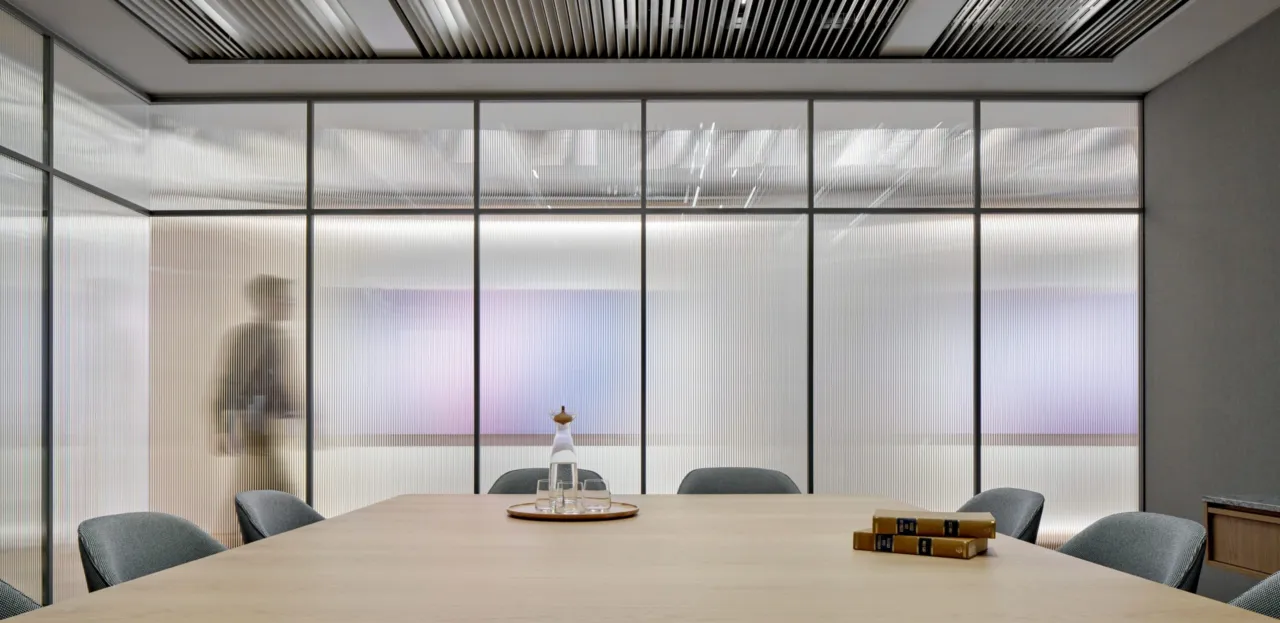
Optima contributes to industry debate and guidance on the reuse of glass partitioning
Optima is an active member of the Alliance for Sustainable Building Products (ASBP) and has contributed to the ASBP’s “The Reuse of Glass Partitioning Systems” guidance. We also took part in ASBP’s industry-wide webinar on the subject earlier this year.
View insight Trends
Is AI amplifying design thinking, or replacing it?
With AI impacting all aspects of work in the design community and construction industry, a question on everyone’s lips is what does this mean for me?
View insight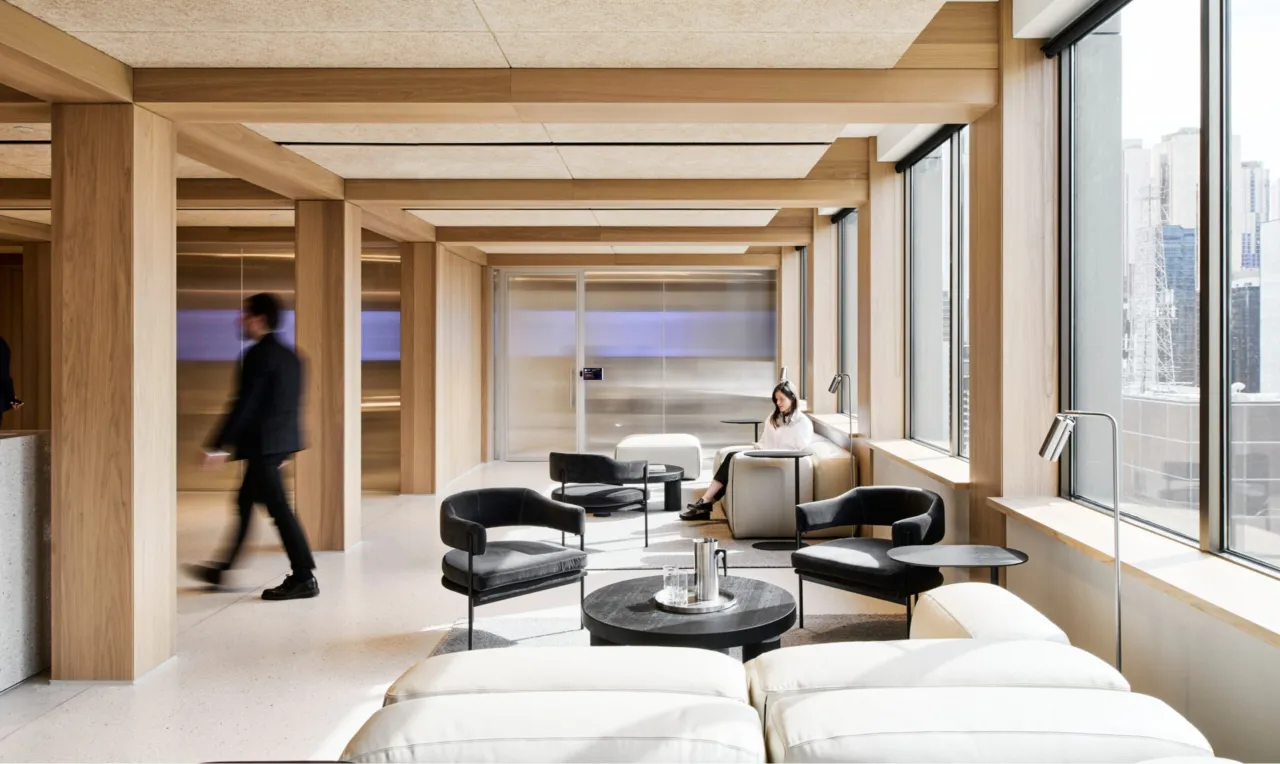 Blog
BlogBeyond Division 8 and 10: How Workplace Design Is Reshaping Collaboration
There is a noticeable shift happening in workplace design. The conversation has moved beyond desk ratios, occupancy density, and space efficiency toward something more human-centered. Increasingly, workplaces are being asked to justify presence rather than simply accommodate it.
View insight

Need help with your next project?
Talk to our team for practical advice on systems, performance and specification.
Enquire now
Sign up to the PurOptima newsletter
Stay up to date with the latest PurOptima innovations, project news and insights from across the global workplace design community